
Diploma in General Surgery
The Medical Council of Thailand
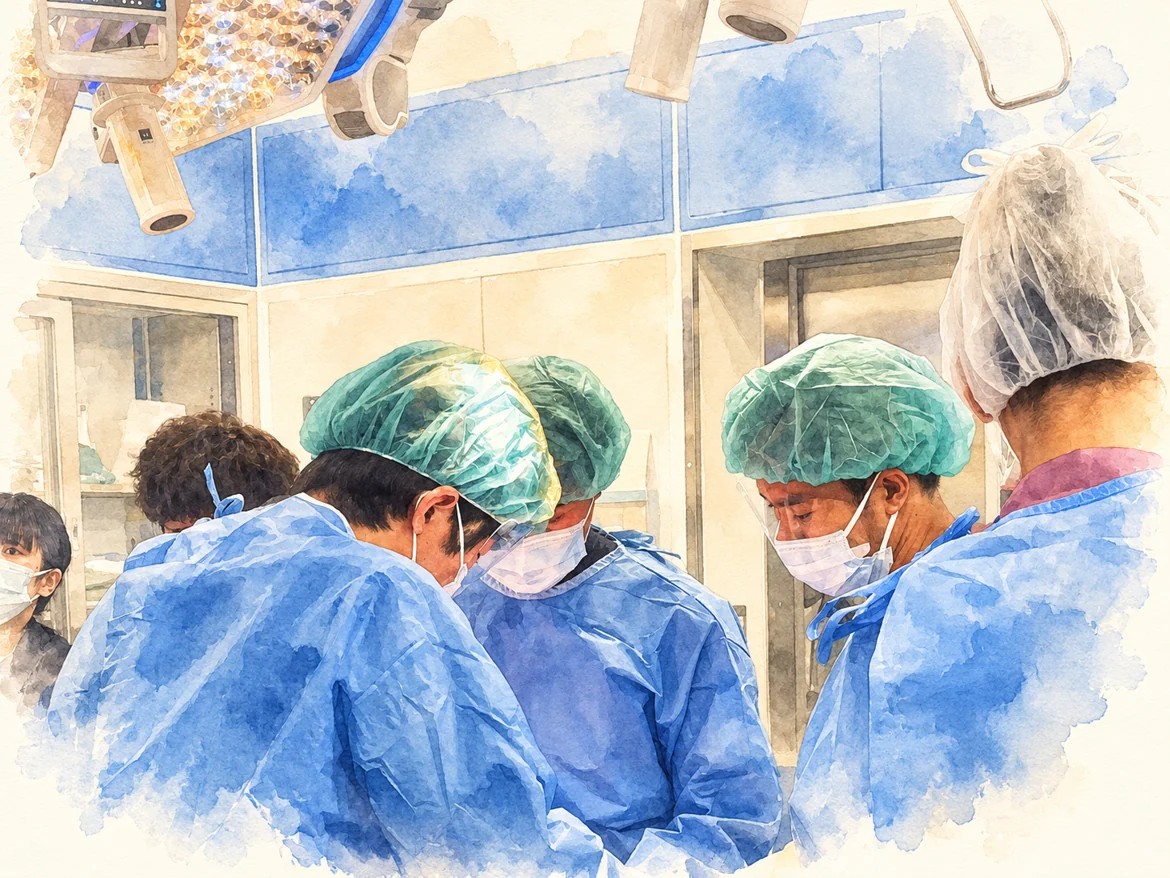
 SHOWA MEDICAL UNIVERSITYNorthern Yokohama Hospital
Learning at Showa Medical University inspires my work in cancer screening, gastrointestinal endoscopy and laparoscopic surgery, with an emphasis on detecting abnormalities early and choosing care appropriate to each patient.
Completed the International Postgraduate Program: Advanced Clinical Training at the International Training Center for Endoscopy & Endoscopic Surgery, Northern Yokohama Hospital.
6 JULY – 2 OCTOBER 2026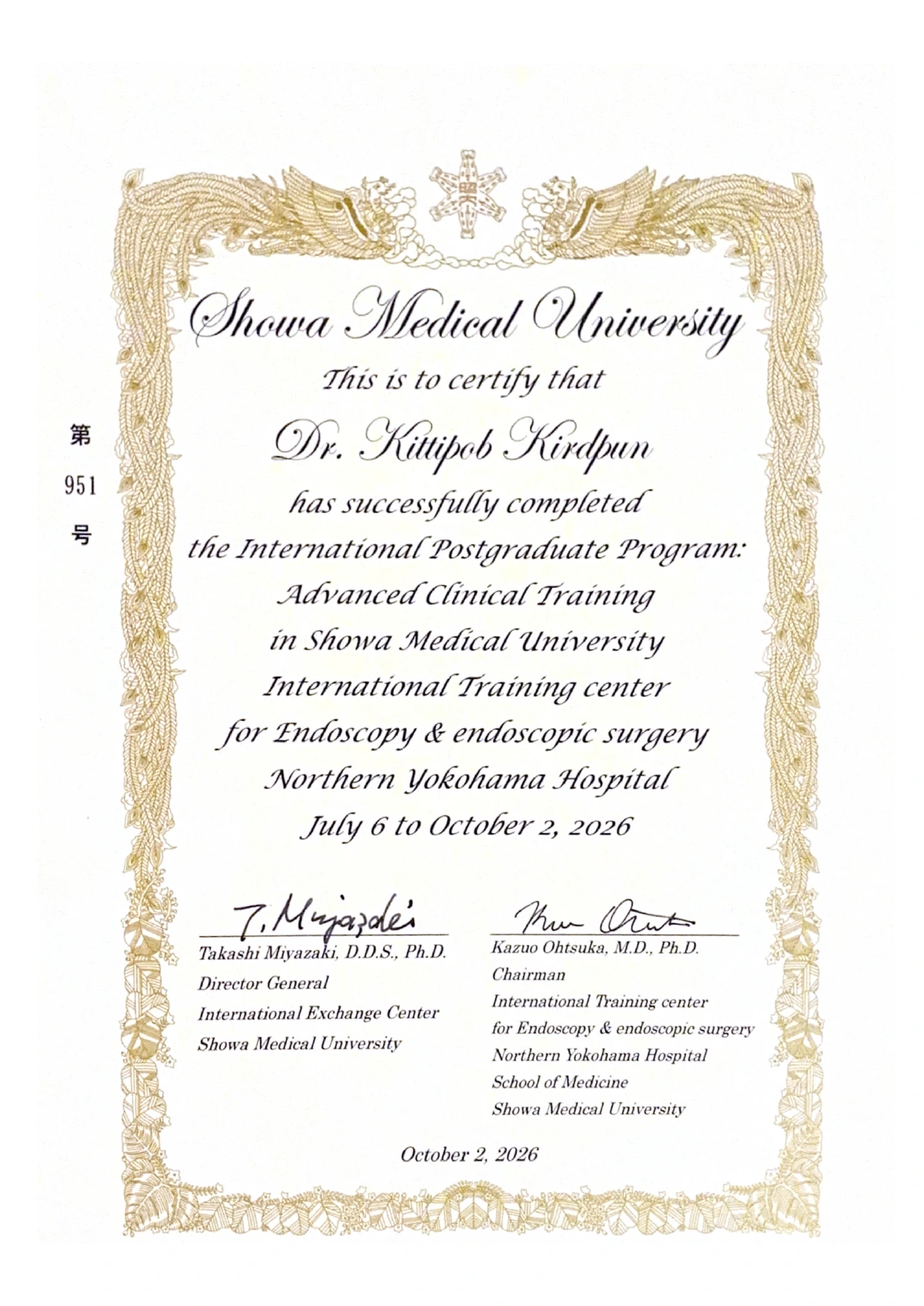

General surgery, endoscopy and keyhole surgery in Hua Hin. My clinical work is supported by surgical training at Siriraj and continued learning in Japan, the United Kingdom and France.
I consult primarily in English and Thai.

 Siriraj Hospital · Mahidol University
The Medical Council of Thailand
The Royal College of Surgeons of Thailand
Faculty of Medicine Siriraj Hospital, Mahidol University
JAPAN · 2026International Postgraduate Program: Advanced Clinical Training · Completed
International Training Center for Endoscopy & Endoscopic Surgery6 July – 2 October 2026Full professional profile JAPAN · 2026
Clinical Observership
Trauma and Acute Critical Care Medical Center17–23 January 2026Full professional profile UNITED KINGDOM · 2024
Clinical Attachment
Manchester, United KingdomFull professional profileAttachments and observerships are learning experiences; they do not confer an overseas medical licence.
Young Investigator Award · ISBI/BBA, Birmingham, UK · Oral research presentation
Choose a concern, understand the options and send an initial question to plan hospital care.
Severe persistent abdominal pain, a very painful or trapped hernia with vomiting, fever with jaundice, or heavy bleeding/faintness needs immediate hospital care. Do not wait for a web reply. Symptoms alone do not confirm a diagnosis.
Discuss a groin lump and compare observation, open repair and keyhole surgery according to your circumstances.
A groin swelling that becomes noticeable with coughing or standing, pain or a recurrent hernia should be assessed to confirm its type and severity.
Options may include laparoscopic TEP/TAPP or open repair. The choice depends on hernia size, location, previous surgery and hospital resources.
What to bring
Bring your operation history and medication list. Discuss mesh, anaesthesia, time off work and when you can return to lifting.
Risks include persistent pain, infection, recurrence and organ injury. A very painful lump that cannot be reduced, especially with vomiting or bloating, needs emergency assessment.
Review gallstones and whether laparoscopic cholecystectomy is appropriate in a hospital setting.
Intermittent right upper abdominal or upper central pain, particularly after meals, or gallstones on ultrasound should be reviewed to establish the cause.
Symptoms, ultrasound and blood tests guide observation or surgery. Not every symptom-free gallstone needs removal. Suspected bile duct stones may need additional investigation or treatment.
What to bring
Bring ultrasound images and reports, blood results, medications and medical history. Ask about the operation, hospital stay and a personalised cost estimate.
Risks include bleeding, bile leak, bile duct injury and conversion to open surgery. Severe pain, fever or jaundice require urgent medical assessment.
Discuss colonoscopy and a screening plan matched to your risk with Dr Kittipob Kirdpun, general surgeon.
Seek assessment for a positive FIT stool test, rectal bleeding, persistent bowel changes, previous polyps or a family history of colorectal cancer. Screening may also be appropriate without symptoms, depending on age and risk.
The consultation considers FIT, colonoscopy and follow-up. Polyps may be removed or sampled when appropriate. A positive FIT is not a cancer diagnosis, but needs further assessment.
What to bring
Bring previous FIT, endoscopy and pathology reports and a medication list. Follow the hospital’s bowel preparation and fasting instructions. Do not stop blood-thinning medicines on your own.
Risks include bleeding, perforation and sedation effects. No test detects every abnormality; follow-up depends on findings and preparation quality.
Understand whether an examination of the oesophagus, stomach and duodenum is appropriate for your symptoms.
Difficulty swallowing, persistent vomiting, unexplained anaemia or upper abdominal symptoms may warrant assessment. Reflux symptoms do not always require endoscopy.
The doctor reviews symptoms, medicines and previous tests. EGD, biopsies or H. pylori testing may be considered according to the indication.
What to bring
Bring previous reports, allergies and your medication list. Follow the hospital’s fasting instructions. Arrange an escort if you receive sedation and follow driving restrictions.
Risks include bleeding, perforation and reactions to sedation. Vomiting blood, black stools with marked weakness or faintness require urgent hospital assessment.
Review investigations, disease stage and surgical options with the hospital team, including laparoscopic colorectal surgery when suitable.
Consult after abnormal pathology, a diagnosis of colon or rectal cancer, or a bowel condition requiring surgical assessment. Symptoms alone do not establish a diagnosis.
Keyhole or open surgery depends on disease location, stage and general health. Some patients need chemotherapy or radiotherapy. A temporary or permanent stoma is considered individually.
What to bring
Bring colonoscopy, pathology, CT/MRI images, blood results and previous treatment records to discuss recovery, nutrition and follow-up.
Risks include bleeding, infection and anastomotic leak. Keyhole surgery is not suitable for everyone. Severe pain, persistent vomiting or distension with no passage of wind require hospital care.
Start with assessment of a breast change, plan appropriate investigations and coordinate hospital-based care.
A new breast or armpit lump, new nipple inversion, skin changes or bloodstained nipple discharge should be checked. Many lumps are benign; do not self-diagnose.
Assessment may include examination, ultrasound, mammography and biopsy. If cancer is found, treatment planning involves the relevant multidisciplinary team and disease type and stage.
What to bring
Bring mammogram and ultrasound images, pathology reports, medicines and family history. A lump does not have to be painful to need assessment.
Cancer cannot be confirmed through chat or a photograph alone. Rapid redness or swelling with fever or deterioration needs prompt medical review.
Hospital assessment of suspected appendicitis and discussion of suitable treatment or surgery.
Persistent abdominal pain, especially in the lower right abdomen, with fever, nausea or worsening symptoms needs hospital assessment. Do not wait for a chat reply.
Examination, blood tests and imaging may guide treatment. Laparoscopic or open appendectomy, or another approach, depends on severity and the individual patient.
What to bring
Tell the team when pain began, your medical conditions, medicines, allergies and any possibility of pregnancy. Bring insurance or healthcare entitlement details.
Abdominal pain has many causes; chat cannot confirm appendicitis. Surgery carries bleeding, infection and other risks. Severe pain or deterioration requires emergency care.
Discuss investigation of suspected bile duct stones and coordinate hospital-based treatment.
Right upper abdominal pain, jaundice, dark urine or abnormal liver tests may warrant investigation. Fever with jaundice or severe pain needs urgent hospital care.
Ultrasound, MRCP or EUS may be considered. Some patients need ERCP or surgery, depending on findings, clinical need and the hospital team and facilities.
What to bring
Bring blood results, ultrasound, CT or MRI reports, medication lists and previous surgical records. Do not stop blood-thinning medicines on your own.
ERCP is not required for everyone and carries risks including pancreatitis, bleeding, infection and perforation. The team assesses benefits and risks before treatment.
Meet Dr Kittipob Kirdpun, MD, FRCST, for assessment, endoscopy, surgical planning and follow-up.
Discuss possible surgical problems such as hernias, gallstones, breast lumps, digestive symptoms or abnormal test results.
The consultation starts with a history and examination, followed by appropriate investigations or referral. Seeing a surgeon does not always mean needing surgery.
What to bring
Bring a symptom timeline, previous tests, operation history, medicines and insurance or healthcare entitlement information.
This website provides information and coordination. Diagnosis and procedures take place in healthcare facilities. For severe or emergency symptoms, go to the nearest hospital without waiting for membership.
For you and those you love
I believe in preventive care: understand your body, know your risks and plan together. Finding some cancers earlier may make treatment easier and lower the chance of dying from them.
Take a small step today. Explore your questions.
New or persistent symptoms need medical assessment rather than waiting for screening. Seek hospital care immediately for severe or emergency symptoms.
Review previous tests and the next appropriate screening date with your doctor. Age alone does not determine every test.
Explore symptoms & care ↗Breast, cervical and prostate screening involve different considerations. Choose according to your organs, history and risk.
Explore symptoms & care ↗Bring family cancer history, previous polyps and test results, smoking history and existing conditions. Some people may need earlier screening.
Explore symptoms & care ↗You can discuss screening before symptoms. Tests have benefits and harms; choose with your doctor rather than testing for everything. NCI ↗
Explore services, preparation for your visit and contact the doctor through our LINE Official Account. No website membership required.
Contact via LINEThis channel handles enquiries and coordination, not diagnosis or prescriptions through chat. Contacting us does not confirm an appointment. For emergencies, seek immediate hospital care.